Do Air Purifiers Help With Pet Allergies? What You Can (and Can’t) Expect
If you’re living with a dog or cat and your eyes water, your nose runs, or your chest feels tight every time you walk into the living room, you might be wondering whether an air purifier is worth the investment. The short answer is yes—air purifiers can reduce airborne pet allergens. The longer answer involves understanding what they can and can’t do, because an air purifier is not a magic cure-all.
Here’s a clear, practical look at how air purifiers work for pet allergies, what to expect, and how to get the most out of one without being disappointed.
Pet Allergies Aren’t Really About Fur
One of the most common misconceptions is that pet fur is the problem. In reality, the allergens that trigger your symptoms mostly come from dander, saliva proteins, and urine—not fur itself. Up to 95% of pet allergens fall into those categories, and pet allergies affect roughly 10–20% of the U.S. population. [3]
Dander is made up of tiny, often invisible flakes of skin that pets shed constantly. Because the particles are so small, they can hang in the air for a long time, circulate through your rooms, and land on furniture, bedding, carpets, and clothing. Pets also bring in outdoor allergens like pollen and dust on their coats, which adds to the total allergen load in your home. [1]
The key takeaway: pet allergens are airborne particles, and that’s exactly what an air purifier is designed to handle.
The Short Answer: Yes, With the Right Filter
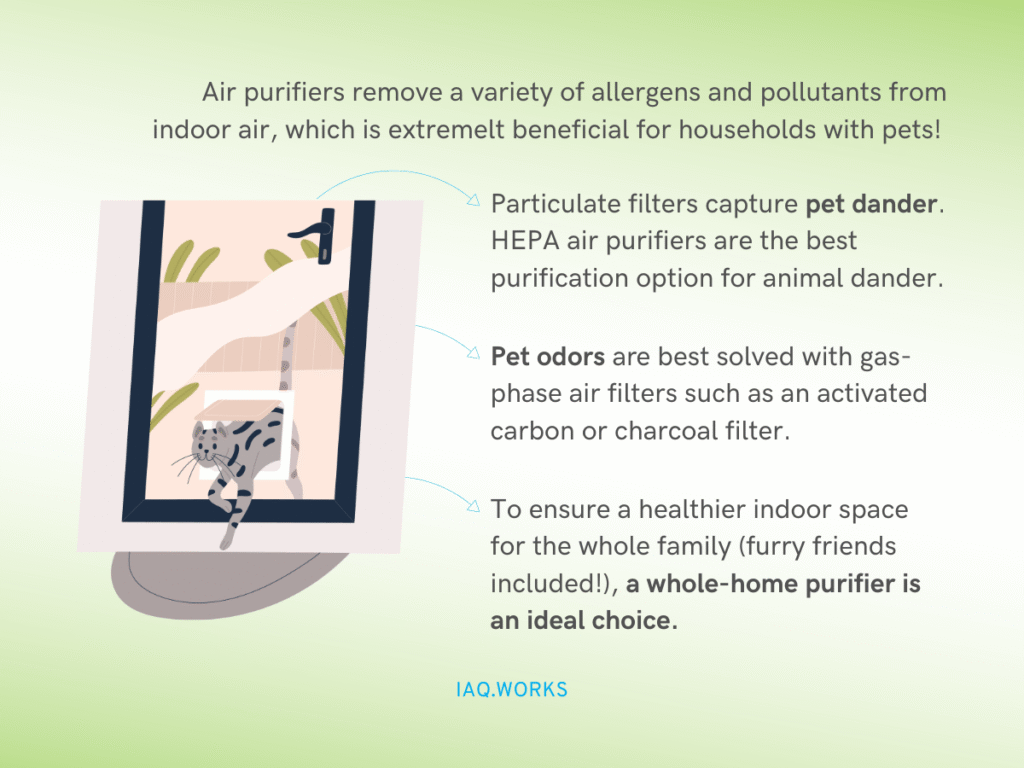
Air purifiers do help with pet allergies, but they need to use the right type of filtration. An air purifier equipped with a true HEPA filter can capture airborne pet dander and allergen-carrying particles. [2]
The Environmental Protection Agency (EPA) has noted that HEPA filters can remove up to 99.97% of dust, pollen, and airborne particles that are 0.3 microns in size. Since pet dander is a type of airborne particle, a HEPA-equipped air purifier can meaningfully reduce the concentration of dander floating in the air. [5]
In practice, this means a good air purifier can help lower the amount of pet allergen you breathe in, especially over time. By continuously filtering the air in a pet-heavy room, the purifier keeps allergens from building up and circulating through your space. [1]
A high-efficiency unit may also capture even smaller allergen proteins. For example, some manufacturers offer filters that claim to trap particles as small as 0.003 microns with 99.5% efficiency. [2] That’s a manufacturer-specific claim, so if you’re comparing models, look for the particle-size efficiency rating on the current product listing and verify it with the manufacturer or retailer before you buy.
What an Air Purifier Can’t Do
This is where expectations matter. Air purifiers are not a complete solution for pet allergies. They can reduce airborne allergens, but they can’t remove allergens that have already settled into carpets, bedding, upholstery, or your pet’s favorite spot on the sofa. [2]
Suggested read: HEPA vs Ionic Air Purifiers for Pet Owners: How to Choose
That’s a critical distinction. If you run an air purifier but never vacuum your carpet or wash your pet’s bedding, you’re only solving half the problem. Pet allergens settle heavily on surfaces, and those settled particles can easily get kicked back into the air when you walk across a rug, sit on a couch, or move around the room.
Air purifiers also won’t eliminate allergies entirely. HEPA purifiers can reduce airborne allergen concentrations by 80–95%, but symptoms can still occur if you’re exposed to allergens on surfaces or during direct contact with your pet. [3]
And not every air purifier is equal. Some purifiers marketed for home use include ionizers or UV light features that supposedly kill bacteria. But there is no scientific data showing that air purifiers with ionizers using UV light are effective for allergy relief. [5] When shopping, focus on HEPA filtration and don’t pay extra for UV or ionizing features unless you’re also getting a high-quality HEPA filter.
How to Make an Air Purifier Work Harder
To get real benefit from an air purifier, don’t just plug it in and forget it. The combination of filtration and smart habits makes a much bigger difference.
Put It Where Your Pets Actually Are
Placement matters. For best results, put the air purifier in the rooms where your pets spend the most time—typically bedrooms and living areas. [2] If your dog sleeps in your bedroom, that’s often the single most important room to cover, because you spend many hours there breathing the same air.
Run It Continuously
Pet allergens don’t stay off the clock, and your purifier shouldn’t either. Running the unit 24/7 in rooms where pets spend the most time helps maintain consistent allergen reduction. If you use it only intermittently, dander can accumulate between cycles. [3]
One common concern is energy use. Most modern purifiers consume only 30–50 watts on low speed, which is comparable to a laptop charger. So running it around the clock is usually more practical than people expect. [3]
Keep Up With Filter Maintenance
A purifier only works as well as its filter. Regular maintenance, including replacing filters as recommended by the manufacturer, keeps the unit operating at peak efficiency. [2] A clogged or overused filter can actually reduce airflow and make the purifier less effective, so check the manufacturer’s recommended replacement schedule and stick to it.
Pair It With Source Control
An air purifier is part of a two-pronged approach: air filtration for airborne allergens and source control to reduce the dander your pet releases in the first place. [3]
A few simple habits go a long way:
Suggested read: Best Air Purifiers for Pet Owners: A Practical, Honest Guide
– Wash your pet’s bedding weekly.
– Vacuum carpets, rugs, and upholstery with a HEPA-equipped vacuum.
– Groom your pet regularly to minimize dander release. [3]
These practices won’t replace an air purifier, but they make the purifier’s job much easier. If you reduce the amount of dander your pet produces, the purifier has less to capture.
What to Look For in a Pet-Specific Air Purifier
When you’re shopping for an air purifier for pet allergies, a few specifications matter more than the marketing claims.
HEPA Filtration
Look for a true HEPA filter, ideally graded as H13. This type of filter is designed to capture fine particles at 0.3 microns, which puts it squarely in the range of airborne dander and allergen proteins. [3] The EPA’s guidance backs this up: HEPA filters can remove up to 99.97% of airborne particles at that size. [5]
CADR and Room Coverage
CADR stands for Clean Air Delivery Rate, and it indicates how quickly a purifier cleans the air in a given room. In the pet-allergy segment, popular units from brands like Levoit, Alen, and Winix often have CADR ratings in the 250–375 CFM range, along with activated carbon layers for odor control. [3]
But don’t assume a number like that will work for every room. CADR is tied to room size, so check the current manufacturer or retailer listing for the unit’s rated coverage area and compare it to the room you’re placing it in. If you have a large open-plan space, you’ll need a higher CADR or possibly more than one unit.
Odor Control
If pet smells bother you, activated carbon is worth looking for. Many popular pet-focused air purifiers include an activated carbon layer to help reduce odors, which can be a nice bonus alongside dander filtration. [3]
Avoid Gimmicks
As mentioned earlier, be cautious with ionizers and UV light features. They may sound high-tech, but there isn’t scientific evidence showing they help with allergies. [5] A solid HEPA filter is what does the real work.
A Realistic Expectation
If you have mild-to-moderate pet allergies, a well-placed HEPA air purifier can noticeably reduce the amount of allergen in your breathing air. Many people find that cleaner air means less severe allergy symptoms. [4]
If your symptoms are severe, or if you have asthma, you may want to consider a higher-grade or medical-grade purifier, which can offer superior filtration and air turnover rates. [2] But even then, an air purifier works best as one part of a larger approach.
Suggested read: Are Roses Toxic to Cats? What Pet Owners in the U.S. Need to Know Right Now
You don’t have to give up your pet just because you have allergies. Pet allergies don’t automatically mean rehoming your dog or cat. With the right combination of air filtration, consistent cleaning, and smart grooming, allergy sufferers can often continue living comfortably with their furry companions. [2]
The Bottom Line
Air purifiers help with pet allergies because they capture airborne dander, saliva proteins, and allergen-carrying dust before you breathe them in. With a true HEPA filter, the effect is real and measurable in terms of reduced airborne allergens.
But air purifiers are not a standalone cure. They won’t remove allergens already settled on furniture, carpets, or bedding, and they won’t eliminate your allergies altogether. To get the best results, run a HEPA air purifier continuously in the rooms where your pet spends the most time, replace filters on schedule, and combine it with regular vacuuming, bedding washes, and grooming.
If you’re ready to buy one, focus on HEPA filtration, CADR, and room coverage. Check the current manufacturer or retailer listing for the exact specifications, because filter grades, CADR ratings, and coverage areas can change from year to year and model to model. And always verify the replacement filter cost before you commit—you’ll need to keep buying them.
Sources:
[1] The Ultimate Guide to Air Purifiers for Allergens & Pets – Levoit\nhttps://levoit.com/blogs/levoit-blog/the-ultimate-guide-to-air-purifiers-for-allergens-and-pets
[2] Do air purifiers help with pet dander? – IQAir USA\nhttps://www.iqair.com/newsroom/pet-owners-allergies-helped-air-purifier
[3] HEPA Air Purifiers for Pet Allergies: Brand Guide 2026 – Homerun Pet\nhttps://homerunpet.com/blogs/pet-care-insights/hepa-air-purifiers-for-pet-allergies-brand-guide-2026
[4] Do Air Purifiers Help With Pet Allergies? What the Science Says – Dreametech\nhttps://homeair.dreametech.com/blogs/blog/do-air-purifiers-help-with-pet-allergies
[5] Air Filter | Treatment – American College of Allergy, Asthma & Immunology (ACAAI)\nhttps://acaai.org/allergies/management-treatment/living-with-allergies/air-filters
Suggested read: What's Behind the Rising Interest in Bengal Cat Price Across the US?