
HEPA vs Ionic Air Purifiers for Pet Owners: How to Choose
If you share your home with dogs or cats, you know the air can carry more than just fur. Pet households deal with a steady stream of dander, tracked litter dust, and odors. Pet allergies affect roughly 10–20% of the U.S. population, and most allergens come from dander, saliva proteins, and urine—not fur alone [3].
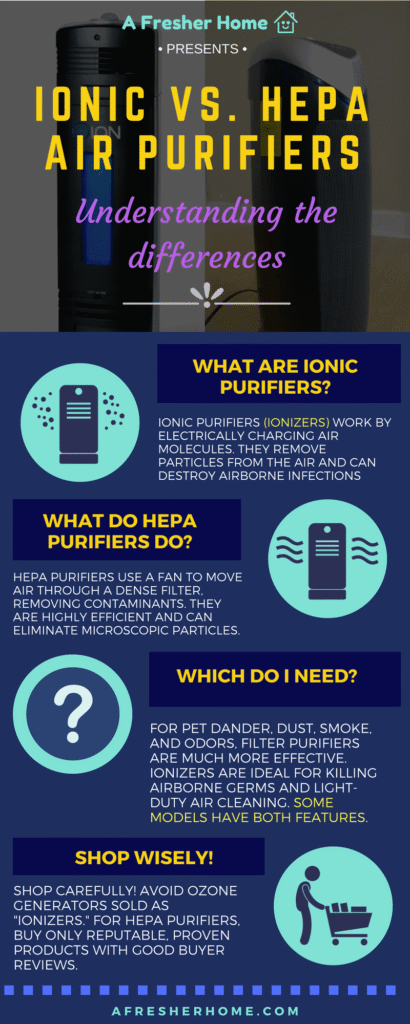
Two popular technologies promise cleaner air: HEPA purifiers and ionic purifiers. They work in very different ways. Before you buy, it helps to understand what each actually does in a room full of shedding pets.
What HEPA Purifiers Do for Pet Households
A HEPA filter is a pleated mechanical air filter. The air purifier uses a fan to draw air through the filter, and the filter traps particles instead of just pushing them around [1][4]. Officially, a HEPA filter can theoretically remove at least 99.97% of dust, pollen, mold, bacteria, and other airborne particles at 0.3 microns [1].
That 0.3-micron specification matters because it is the "most penetrating particle size" — the worst case. Particles that are larger or smaller are captured with even higher efficiency [1]. Pet allergens are often under 2.5 microns, which is why true HEPA filtration is considered important for pet homes [6].
For pet owners, one of the most important distinctions is "true HEPA" versus "HEPA-type" or "HEPA-style." Only true HEPA filters meet the 99.97% standard. Many budget purifiers use HEPA-type filters that capture far less. Always verify the filter specification before buying [6].
A HEPA purifier also needs a dedicated pre-filter stage in a pet home. Pet hair will clog a HEPA filter prematurely if there is no pre-filter to catch it first. Look for a washable or replaceable pre-filter that is separate from the main HEPA unit, with enough surface area for heavy shedding and easy access for cleaning every 2–4 weeks during shedding season [6].
For pet odors, look for an activated carbon layer. One brand guide notes that activated carbon is what handles litter box ammonia and urine odors, and a heavier carbon filter can make a noticeable difference [3][6].
How Ionic Air Purifiers Work
Ionic purifiers, also called air ionizers, don’t use a fan and filter the same way. Some have no filter at all—and in some cases, not even a motor. They emit a negative ion charge designed to attach to airborne particles. Once charged, those particles are more likely to stick to surfaces [5].
This is where the problem begins for pet owners. The charged particles don’t discriminate about where they attach. They can land on carpeting, walls, your clothes—and worst case, your lungs [5]. For mold spores, you don’t want them floating and then sticking to the walls. You want to catch them in the purifier [5].
Suggested read: Can Air Purifiers Help With Pet Shedding?
Air ionizers are not recommended for relief from allergies or any other respiratory condition [5]. For air cleaning performance, HEPA filter-based media is considered the best technology [5][6].
There is also an ozone concern. Ionizers and ozone generators produce ozone, which is harmful to both human and animal respiratory systems. California’s CARB restricts ozone-emitting devices for this reason [6]. Filterless “plasma” purifiers are often marketing jargon with limited independent testing. Many guides recommend sticking with mechanical HEPA filtration backed by third-party certifications [6].
That said, some HEPA purifiers include an ionization stage. For example, one brand guide describes the Winix 5500-2 as using PlasmaWave ionization to break down allergens without producing ozone, and it is CARB certified [3]. If you consider any model with an ionizer, verify the CARB certification and the manufacturer’s ozone claim rather than relying on the marketing language [3][6].
HEPA vs Ionic for Pet Owners: A Practical Comparison
| Factor | HEPA purifier | Ionic purifier |
|---|---|---|
| How it works | Fan draws air through a pleated mechanical filter [1][4] | Emits negative ions to charge particles, which stick to surfaces [5] |
| Capture efficiency | At least 99.97% at 0.3 microns, with even higher efficiency for larger or smaller particles [1] | No filter-based capture rating; particles may settle on walls, clothes, or in lungs [5] |
| Pet allergens | Targets dander, dust, and other particles that trigger allergies [1][4] | Not recommended for allergy relief [5] |
| Pet hair management | Requires a separate pre-filter to avoid premature clogging [6] | No filter to clog, but hair and dander may just land on surfaces [5] |
| Odor control | Requires an activated carbon stage [3][6] | On its own, ionization is not a substitute for carbon; look for a carbon stage on any purifier [3][6] |
| Ozone safety | HEPA filtration itself does not produce ozone | Some ionizers emit ozone; CARB restricts ozone-emitting devices [6] |
| Maintenance | HEPA filter replacement typically every 9–12 months in many models; pre-filter cleaning during shedding season [3][6] | No HEPA filter to replace, but charged particles accumulate on surfaces and need cleaning [5] |
The practical takeaway is simple: if your primary goal is removing airborne pet dander, a HEPA-based purifier is the better default. One air purifier manufacturer puts it bluntly: HEPA filter-based media is the best technology, and air ionizers are not recommended for allergies [5].
Practical Limitations to Keep in Mind
HEPA is not a substitute for source control
Pet allergies are driven by dander, saliva, and urine proteins—not just fur [3]. That means a purifier alone won’t stop the dander your pet sheds. Managing pet allergies requires two approaches: air filtration to remove airborne allergens and source control to minimize dander release during grooming [3]. In practice, that means regular brushing, vacuuming, washing pet bedding, and keeping your pet clean.
HEPA filters need a pre-filter and replacement
In a pet home, hair clogs filters fast. A washable pre-filter is essential. Clean it every 2–4 weeks during heavy shedding. HEPA filters themselves are generally replaced every 9–12 months in the common examples in brand guides [3][6]. Filter life and replacement costs change by model, so check the current manufacturer listing before you buy.
Ionic purifiers can leave messes behind
Because ionizers charge particles and let them settle, you may still need to clean walls, carpeting, and fabrics. That’s not the same as removing the dander from the air [5]. If you already own an ionic purifier, consider running it as a supplement to a HEPA unit—not as your primary pet-allergy solution.
Ozone and certifications matter
If you’re tempted by an ionizer, verify safety first. CARB restricts ozone-emitting devices, and ozone is harmful to both people and pets [6]. Avoid any model labeled as an ozone generator. For a HEPA purifier with a built-in ionizer, check that the ionizer stage is CARB certified, and look for third-party verification like AHAM [3][6].
Match the purifier to the room
An undersized desktop purifier will not clean a living room [6]. Look at the Clean Air Delivery Rate (CADR) and coverage area when comparing models [2][3]. In one brand guide, the Winix 5500-2 is listed at 360 square feet with a CADR of 243 CFM for dust and 246 CFM for pollen. The Alen BreatheSmart 75i is listed for up to 1,300 square feet with a CADR of 347 CFM [3]. Those specs come from a 2026 guide and can change, so always verify the current listing before purchasing.
Suggested read: Air Purifier Maintenance for Pet Owners: Cleaning and Filter Care
Prices also change. The same guide lists the Winix 5500-2 at $150–250 and the Alen BreatheSmart 75i at $600–700 [3]. That is a snapshot, not a current price. Check the manufacturer or retailer listing for price, stock, filter life, and package contents.
Recommendations for Pet Owners
1. Start with source control. Grooming, vacuuming, and washing pet bedding reduce the dander load before it ever reaches the air [3].
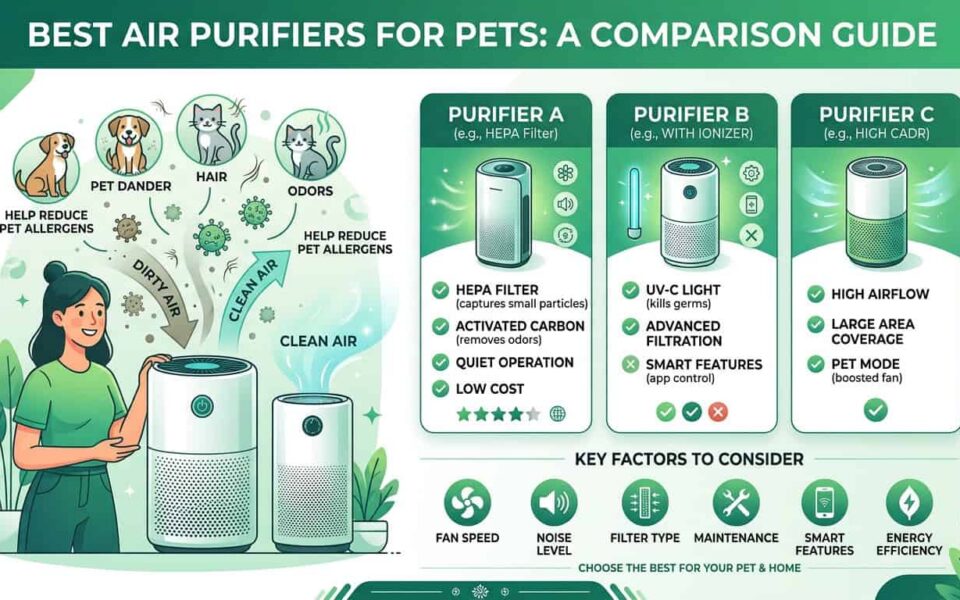
2. Choose true HEPA with a washable pre-filter and activated carbon. This combination handles both particles and odors, and the pre-filter protects your HEPA filter from pet hair [3][6].
3. Match CADR and coverage to your actual room size. A small unit in a large room is not a solution [2][6].
4. If you consider an ionic purifier, verify CARB certification and ozone claims. Do not rely on marketing promises like "plasma" or "break down allergens" without independent certification [3][6].
5. Use an ionizer only as a supplement, not a replacement. The HEPA filter is the primary layer that actually captures allergens [1][5].
Bottom Line
For pet owners, HEPA is the more practical technology. It mechanically captures the small allergens that trigger symptoms, and with the right pre-filter and carbon stage, it also controls hair and odors. Ionic purifiers can be quieter and have fewer filters to replace, but they don’t capture pet dander the same way, and they can leave charged particles on your walls, floors, and clothes [5][6]. Ozone concerns only add to the caution.
If you buy a HEPA purifier, look for true HEPA certification, a washable pre-filter, an activated carbon layer, and a CADR rating matched to your room. Then combine it with regular grooming and cleaning. That combination—not the purifier alone—is what makes a pet home feel fresher.
—
*Disclosure: This article is independent and contains no affiliate links. Mention of specific products is for comparison only. Always verify current pricing, availability, certifications, and specifications with the manufacturer or retailer before purchasing.*
Sources
[1] What is a HEPA filter? | US EPA\nhttps://www.epa.gov/indoor-air-quality-iaq/what-hepa-filter
[2] Assessing effectiveness of air purifiers (HEPA) for controlling indoor particulate pollution\nhttps://pmc.ncbi.nlm.nih.gov/articles/PMC8449022
[3] HEPA Air Purifiers for Pet Allergies: Brand Guide 2026\nhttps://homerunpet.com/blogs/pet-care-insights/hepa-air-purifiers-for-pet-allergies-brand-guide-2026
[4] Air Purifiers: HEPA vs. Ionic Filters | Air Health\nhttps://airhealth.com/blog/air-purifiers-hepa-vs-ionic-filters
Suggested read: What Size Air Purifier Do I Need for Pet Owners?
[5] Ionic Air Purifier vs HEPA – What Is Best For You?\nhttps://oransi.com/blogs/blog/ionic-air-purifiers-vs-hepa-air-purifiers
[6] Best Air Purifier for Pets 2026: Complete Buyer's Guide | WISESKY\nhttps://wisesky.com/blogs/category-product-tips/how-to-choose-the-best-air-purifier-for-pets-in-2026-a-complete-buyers-guide


This Post Has 4 Comments