In this guide
Why Beginners Need a Reliable Water Test Kit
An aquarium looks calm and simple from the outside, but the water inside is a constantly changing chemical environment. Fish waste, uneaten food, and decaying plant matter all break down into compounds that can harm your animals. In a new tank, these compounds can build up faster than a beginner expects, and the damage is often invisible until fish start behaving strangely or dying.
A water test kit is how you make that invisible chemistry visible. Instead of guessing whether a water change is overdue, you measure the key parameters and act on the numbers. For beginners, the goal is not to become a water chemist. The goal is to reliably answer a few practical questions: Is the tank cycled? Is ammonia building up? Is the pH stable? Are nitrates getting too high between water changes?
This guide covers the types of test kits available, which ones suit beginners, what to test and how often, and common mistakes that lead to misleading results. Product availability, packaging, and specific kit contents change over time, so treat any product names here as starting points for your own current research rather than a fixed buying list.
The Main Types of Test Kits (and Which Suits Beginners)
Home aquarium test kits generally fall into three categories: liquid (drop) test kits, test strips, and electronic meters. Each has trade-offs in accuracy, cost, convenience, and ease of use.
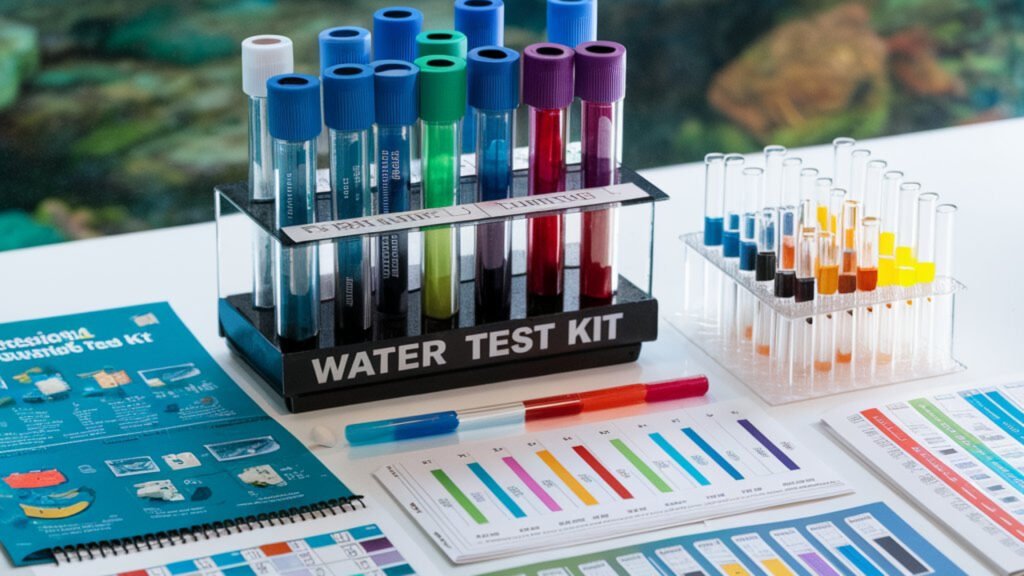
Liquid test kits require you to add a measured amount of tank water to a test tube, add drops of reagent, shake, and compare the resulting color against a chart. They take more time and involve more steps, but they are generally considered more accurate and more precise than strips, especially for ammonia and nitrate. Most experienced hobbyists and beginner guides recommend liquid kits as the primary testing method.
Test strips are dipped into the water and read after a short wait. They are fast and easy, which makes them appealing for beginners, but they typically offer coarser readings and can be affected by storage conditions, humidity, and timing. They can be useful for quick spot checks, but they are a weaker choice for monitoring a new tank through its cycle.
Electronic meters and monitors measure parameters such as pH, temperature, or conductivity digitally. Handheld pH meters are popular, and some continuous monitors can alert you to changes. They cost more, require calibration and maintenance, and vary widely in quality. They are not necessary for most beginners, though a simple digital thermometer is a worthwhile, low-cost addition.
There is also a practical distinction between individual test kits and master test kits. A master kit bundles tests for the most important parameters in one box, usually at a lower cost per test than buying each separately. For a beginner setting up a first tank, a liquid master kit covering ammonia, nitrite, nitrate, and pH is usually the most sensible single purchase.
Essential Parameters Every Beginner Should Test
You do not need to test everything. A small set of parameters covers the vast majority of beginner problems. The table below summarizes what each one means and why it matters.
| Parameter | What It Indicates | Why Beginners Should Care |
|---|---|---|
| Ammonia (NH₃/NH₄⁺) | First stage of the nitrogen cycle; produced by fish waste and decomposing matter | Toxic to fish even at low levels; a reading above zero in an established tank signals a problem |
| Nitrite (NO₂⁻) | Second stage of the nitrogen cycle | Also toxic; should fall to zero once the tank is fully cycled |
| Nitrate (NO₃⁻) | End product of the cycle; removed by water changes and plants | Rising nitrate is the main reason for routine water changes |
| pH | Acidity/alkalinity of the water | Affects fish health and how toxic ammonia is; sudden swings are more dangerous than a stable unusual value |
| General hardness (GH) and carbonate hardness (KH) | Mineral content and buffering capacity | Important for many species and for pH stability; often included in broader kits |
Ammonia, nitrite, and nitrate are the core trio for beginners because they tell you whether your tank’s biological filter is working. pH matters because fish have preferred ranges, and because a low pH changes how much of the ammonia in the water is in its more toxic form. GH and KH are secondary for a first freshwater community tank but become important if you keep sensitive species, shrimp, or certain plants, or if your tap water is unusually soft or hard.
For saltwater tanks, additional parameters such as salinity, alkalinity, calcium, and magnesium matter, but those are usually beyond a true beginner’s first setup. If you are starting a marine tank, choose kits designed specifically for saltwater and expect a steeper learning curve.
How to Choose a Beginner-Friendly Kit: Practical Checklist
Rather than chasing a single “best” product, evaluate kits against your actual needs. The following checklist covers the factors that matter most.
- Parameter coverage: Does it include ammonia, nitrite, nitrate, and pH at minimum? A kit missing ammonia is a poor choice for cycling a new tank.
- Liquid vs. strip: For a first tank, prefer liquid reagents for the nitrogen compounds, even if you also keep strips for quick checks.
- Clear color chart: The chart should have distinct, well-separated color steps. Kits with subtle gradations are harder to read and more error-prone.
- Readable units: Check whether readings are in ppm or mg/L (they are equivalent for these tests) and whether the scale matches the levels you care about.
- Number of tests per kit: A cheap kit with very few tests can cost more per test than a larger master kit. Compare cost per test, not just box price.
- Refill availability: Reagents expire and run out. Kits from brands with widely available refills are more economical long-term.
- Expiry dates: Check the date on the box or bottles when buying. Old reagents give inaccurate results.
- Instructions quality: Good kits include clear step-by-step instructions, including how long to shake and how long to wait before reading.
- Storage requirements: Some reagents need to be kept cool and dark. Make sure you can store the kit as directed.
Two more points deserve emphasis. First, a kit is only as good as its reagents, so buy from a retailer with reasonable turnover rather than a dusty clearance box. Second, if you keep more than one tank or plan to expand, a master kit that covers GH and KH as well as the core parameters often makes more sense than buying add-on kits later.
How to Test: A Simple Beginner Routine
Consistency matters more than perfection. Follow the kit’s instructions exactly, because small variations in sample volume, drop count, shaking time, and waiting time can shift the color you see. Use the test tubes supplied with the kit, rinse them with tank water before and after use, and keep your fingers off the inside of the tube. Read results in good, neutral lighting, ideally against a white background, and hold the tube at the distance the instructions specify.
A practical routine for a new freshwater tank looks like this:
- During cycling: Test ammonia and nitrite most days, or every other day, until ammonia and nitrite both read zero and nitrate is present. This confirms the tank has cycled.
- First weeks after adding fish: Test ammonia and nitrite every few days, and nitrate weekly. New tanks can wobble as the bacterial population adjusts to the bioload.
- Established tank: Test nitrate and pH weekly, and ammonia and nitrite if something seems wrong — cloudy water, gasping fish, unusual behavior, or a death in the tank.
- After any change: Test after adding new fish, changing filter media, medicating, or doing a large water change, since each of these can disturb the balance.
Record your results. A simple notebook or spreadsheet with dates and readings turns isolated numbers into a trend you can actually interpret. A nitrate level that has crept up over three weeks tells you something different from a single high reading.
Common Mistakes That Give Misleading Results
Many “bad test results” are actually testing errors. Watch for these common problems:
- Reading too early or too late: Color development is time-dependent. A nitrate test read at two minutes when the instructions say five will understate the result.
- Not shaking reagents: Some bottles, especially nitrate reagents, contain crystals or settled material and must be shaken vigorously before use.
- Using expired or improperly stored reagents: Heat, sunlight, and age all degrade test chemicals.
- Contaminated tubes: Residue from a previous test or from tap water can skew readings. Rinse thoroughly.
- Poor lighting and background: Color comparison is subjective. Use consistent lighting and a white background every time.
- Ignoring the difference between total ammonia and free ammonia: Many kits measure total ammonia, which includes the less toxic ammonium form. At low pH, more ammonia is in the safer form, but total ammonia still needs to be near zero in a healthy tank.
- Chasing a “perfect” pH: Stability matters more than hitting an exact number. Adjusting pH with chemicals often causes swings that are worse than a slightly “off” but stable value.
Practical Buying Advice and What to Skip
For most beginners keeping a freshwater community tank, the most practical purchase is a liquid master test kit covering ammonia, nitrite, nitrate, and pH, plus GH and KH if the price difference is small. Add a separate ammonia test if your master kit lacks one, since ammonia is the parameter you will check most often during cycling. Buy fresh, check expiry dates, and store the kit as directed. If you want the convenience of strips for quick daily checks, that is fine, but confirm any concerning strip result with a liquid test before making big changes.
What can a beginner reasonably skip? Multi-parameter electronic monitors, elaborate reef-specific test suites, and single-parameter kits for parameters you do not yet need. Also skip pH-adjusting chemicals until you understand your water’s KH and why your pH behaves as it does. And be cautious with any product claiming to make testing unnecessary; no additive replaces the information a test kit provides.
Finally, remember that product lines change, kit contents get revised, and reagent formulations are updated. Before buying, check the current product description and recent reviews for the exact kit you are considering, and confirm it still includes the parameters you need. The principles in this guide — liquid reagents for the core nitrogen parameters, consistent technique, and regular record-keeping — will serve you well regardless of which specific kit you choose.