Start With the Job the Harness Has to Do
A dog car safety harness is not just a pet accessory. It is a piece of equipment intended to do two jobs at once: keep your dog restrained enough that they cannot distract you or climb into the front seat, and distribute force across the dog’s body if the vehicle stops suddenly. Those two goals help explain why a cheap walking harness with a seatbelt loop sewn on is rarely the best answer.
Before comparing products, decide what you actually need. A dog who rides daily on short trips has different requirements from a dog who travels a few times a year. A small dog in the back seat of a sedan may be well served by a crash-tested harness used with the vehicle’s seatbelt, while a large dog in an SUV or hatchback may need a harness paired with a crate or a cargo-area barrier instead. There is no single best harness for every dog and every car, so the most useful approach is to understand the criteria and then match them to your situation.
It also helps to be realistic about what any harness can do. No harness can guarantee a dog will be uninjured in a serious collision. What a well-designed, properly fitted harness can do is reduce the chance of the dog becoming a projectile, limit their movement inside the cabin, and spread restraint loads over sturdier parts of the body rather than the neck. That is a meaningful benefit, but it is a risk-reduction measure, not a guarantee.
Look for Independent Crash Testing and Understand What It Means
The single most useful screening question is whether a harness has been crash tested, and by whom. Some manufacturers test their own products and publish results. Others submit harnesses to independent testing organizations. These are not the same thing, and the difference matters when you are comparing claims.
Independent testing programs for pet travel products have existed for years, and their criteria and ratings can change over time. Because testing standards, product lineups, and published results are updated periodically, treat any specific list of “approved” or “top-rated” harnesses as something to verify at the time you shop rather than as a permanent fact. Check the testing organization’s current published information and the manufacturer’s current documentation, and confirm that the exact model and size you are buying is the one that was tested. A common trap is that a brand’s reputation for testing one model gets applied to every harness it sells, including models that were never tested at all.
When you look at test information, ask a few practical questions:
- Which specific model and size was tested? Results for a small size do not automatically transfer to a large size.
- What kind of test was performed? A sled test simulating a frontal impact is the most common approach; some programs also evaluate factors like fit and ease of use.
- Who conducted the test? Independent testing carries more weight than in-house testing, though in-house testing is not meaningless.
- Is the documentation current? Product designs change, so confirm the information you are reading matches the version being sold now.
If a manufacturer makes vague claims like “crash tested” without naming the test, the organization, or the model, that is a signal to dig deeper or look elsewhere. Legitimate testing information is usually specific.
Fit Is Not a Detail: How the Harness Should Sit on Your Dog
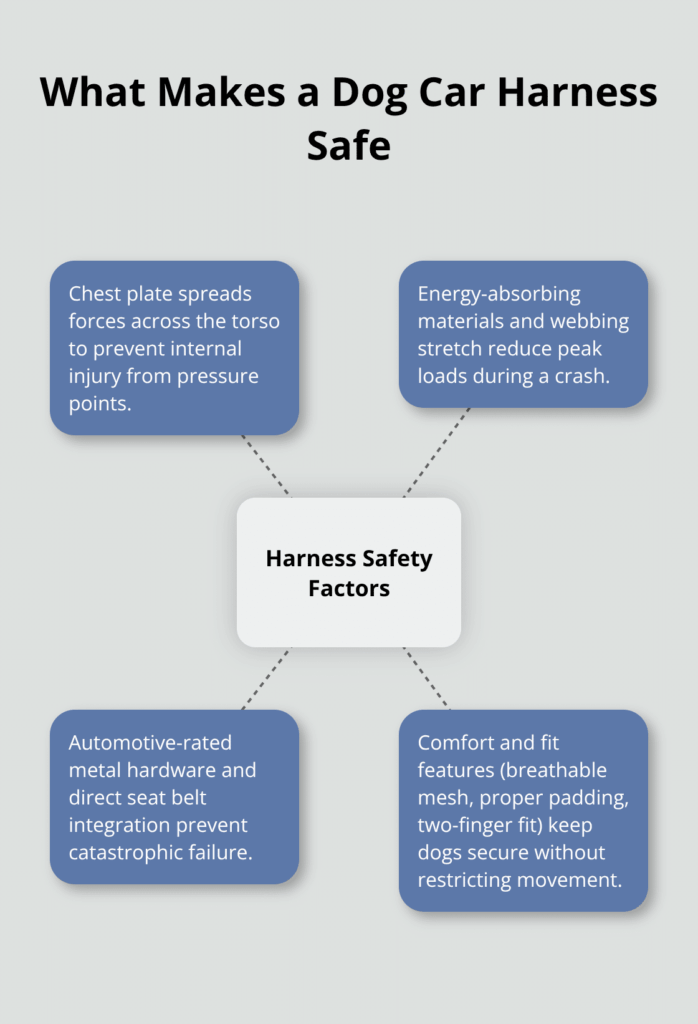
Even a well-tested harness can underperform if it does not fit. A loose harness lets the dog shift forward before the restraint engages, and a harness that is too tight can rub, restrict breathing, or concentrate force in the wrong place. Fit is also where many online purchases go wrong, because sizing varies between brands and does not map cleanly to collar sizes or weight alone.
Measure your dog rather than guessing. Most harness makers publish a sizing guide based on girth, the circumference of the ribcage just behind the front legs, and sometimes chest depth or neck size as well. Measure with a soft tape while the dog stands, and measure more than once if your dog is wiggly. If your dog falls between sizes, follow the manufacturer’s guidance rather than assuming you should size up.
Once the harness arrives, check these fit points:
- Girth straps should be snug enough that you can fit roughly two fingers underneath, without the harness twisting or sliding sideways.
- The chest plate should sit centered on the sternum and not press into the throat or dig into the armpits.
- The back panel should lie flat without bunching, and the attachment point for the seatbelt should sit where the manufacturer intends.
- Range of motion should be comfortable: the dog should be able to sit, lie down, and stand without the harness pulling tight.
- No rubbing after a short test walk or a few minutes in the car. Check under the front legs and along the chest, where friction is most common.
Fit should also be rechecked as your dog grows, gains or loses weight, or grows a thicker or thinner coat with the seasons. A puppy will outgrow a harness quickly, and a harness that fit in winter may be loose in summer.
Restraint Method: Seatbelt, Tether, or Something Else
How the harness connects to the vehicle matters as much as the harness itself. There are several common approaches, and each has trade-offs.
| Method | How it works | Things to consider |
|---|---|---|
| Seatbelt through harness loops | The vehicle’s own seatbelt threads through designated loops on the harness. | Uses the vehicle’s engineered restraint system, but fit and routing matter; follow the manufacturer’s instructions and check that the belt does not sit across the dog’s neck. |
| Seatbelt with a tether or strap | The seatbelt buckle or a dedicated anchor connects to the harness via a short strap. | Allows some movement; keep the tether short enough that the dog cannot reach the front seats or window edges. |
| Crate or carrier secured in the vehicle | The dog rides in a crate that is itself restrained or sized to fit the cargo area. | Often a strong option for larger dogs, but the crate must be secured and appropriately sized; an unsecured crate can become a hazard. |
| Cargo barrier with harness | A barrier separates the cargo area, and a harness limits movement within it. | Works well in some vehicles; check that the barrier is properly installed and rated for the dog’s weight. |
Whichever method you use, place the dog in the back seat or cargo area rather than the front passenger seat. Front seats bring airbag deployment into the picture, and an airbag designed for a human can injure a dog. If your vehicle has a passenger seat sensor, a dog’s weight may or may not trigger it correctly, which is another reason to keep dogs in back.
Attachment hardware deserves a close look too. Metal buckles and reinforced stitching generally inspire more confidence than thin plastic clips, but construction details vary widely and are hard to judge from photos. If you can inspect the harness in person, check the stitching at load-bearing points and the thickness of the webbing.
Comfort, Behavior, and Everyday Practicality
A harness only helps if your dog will wear it without distress and if you will actually use it every trip. Comfort and usability are therefore legitimate selection criteria, not afterthoughts.
Consider how the harness goes on and off. Over-the-head designs suit some dogs, while step-in or clip-on-every-side designs are easier for wriggly dogs or for owners with limited hand strength. Padding around the chest and straps can improve comfort on longer trips, though padding should not interfere with fit or hide poor construction. Look for adjustable straps at multiple points so you can fine-tune the fit rather than relying on a single adjustment.
Behavior matters as well. Some dogs settle better with a bit of freedom to lie down, while others do better with more restriction. If your dog is anxious in the car, a harness is not a substitute for addressing the anxiety; it is safety equipment. Speak with your veterinarian about motion sickness or severe travel anxiety if that is part of your situation.
Practical details worth checking before you buy:
- Washing instructions. A harness that cannot be cleaned will get unpleasant quickly, especially on muddy walks before car rides.
- Hardware durability. Check reviews for reports of buckles failing or straps loosening, while remembering that reviews vary in reliability.
- Return policy. Fit problems are common, so a return or exchange option reduces the risk of an expensive mistake.
- Compatibility with your vehicle. Some harnesses work better with certain seatbelt configurations or seat shapes than others.
- Dual use. If the harness also works for walking, you are more likely to use it consistently, but make sure the walking attachment does not compromise the car restraint design.
A Simple Buying Checklist
Pulling the criteria together gives a practical sequence. First, confirm the specific harness model and size has credible crash test information, and verify that the information is current rather than relying on a brand’s general reputation. Second, measure your dog and choose a size based on the manufacturer’s girth guidance, planning to recheck the fit after purchase. Third, decide how the harness will connect to your vehicle, keeping the dog in the back seat or cargo area and using a short tether or the seatbelt as the manufacturer directs. Fourth, check construction details such as stitching, webbing, and buckles, and confirm the harness can be cleaned and returned if it does not fit. Finally, introduce the harness gradually at home before relying on it in the car, and recheck fit regularly.
It is also worth remembering that standards, testing programs, and product designs change. Information that was accurate a few years ago may no longer describe the current version of a harness or the current criteria of a testing organization. Treat any recommendation, including this article’s general guidance, as a starting point for your own verification rather than a substitute for checking current sources at the time of purchase. A careful, slightly skeptical buyer who checks the specific model, the specific size, and the specific test information is in a much better position than one who buys on brand name or price alone.
Finally, pair the harness with safe driving habits. Secure the harness before the car moves, keep the dog in the back, avoid letting the dog ride with their head fully out the window, and never leave a dog unattended in a parked vehicle in weather that could become dangerous. The harness is one part of a broader approach to traveling safely with your dog, and the choices you make around it are just as important as the product itself.