Choosing the right stroller for your furry friend can feel like a decision between two very different worlds. On one hand, you have the nimble, sporty three-wheel model that seems perfect for jogging and crowded sidewalks. On the other, the stable, roomy four-wheel design promises a smoother ride and more cargo space for weekend errands. Both are popular, but they serve distinct purposes. If you are weighing the options for your canine companion, understanding the structural and practical differences between a three-wheel and a four-wheel dog stroller is the first step to making the right call for your lifestyle, your dog’s size, and your daily terrain.
This guide breaks down the pros and cons of each configuration in plain language. We will look at maneuverability, stability, weight capacity, and storage, so you can confidently select the stroller that will keep your senior, disabled, or simply pampered pup comfortable and safe on every outing.
Understanding the Basics: Wheel Configurations
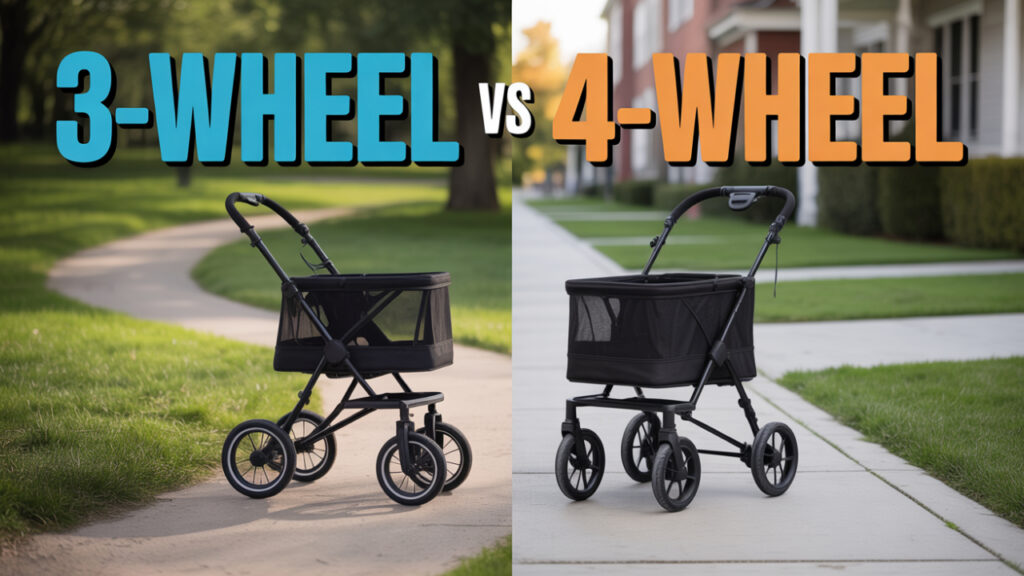
At first glance, the difference seems obvious—one has three wheels, the other has four. But that single wheel has a cascading effect on the stroller’s geometry, weight distribution, and steering mechanism. Three-wheel strollers typically have a single swivel wheel at the front and two fixed wheels at the back. This design allows for a tighter turning radius and makes the stroller feel more like a bicycle or a shopping cart that pivots from the front. The front wheel often locks in place for straight-line travel, which is a key feature for joggers.
Four-wheel dog strollers, on the other hand, usually feature two sets of wheels—often with the front pair swiveling (and lockable) and the rear pair fixed. This configuration creates a stable, rectangular base that distributes weight more evenly across the entire footprint. While the turning radius is typically wider than a three-wheel model, the added width and length provide a less tippy experience, especially when your dog shifts position or when you are navigating curbs and uneven pavement. The choice ultimately comes down to what you value more: agility or equilibrium.
It’s also worth noting that wheel size matters just as much as wheel count. A three-wheel stroller with large, air-filled tires can handle rough trails better than a four-wheel stroller with small plastic wheels. Conversely, a four-wheel stroller with rubber EVA wheels will be smoother on flat sidewalks than a three-wheel model with tiny casters. Keep this in mind as we dive into the specific advantages.
Pros and Cons of Three-Wheel Dog Strollers
Three-wheel models are often the default choice for active pet parents who don’t want to slow down. Because they are designed with a single front pivot point, they offer exceptional maneuverability. You can navigate tight corners in a park, weave through pedestrian traffic, and turn the stroller with a simple wrist twist. This is a huge plus if you live in a bustling city or frequently navigate narrow shop aisles. Many three-wheel strollers also come with a front wheel that locks, transforming the stroller from a swivel-mode to a fixed-wheel mode for straight-line jogging or fast walking. The design is also inherently lighter in some cases, as fewer wheels and forks mean less overall weight.
However, that agility comes with a trade-off. Three-wheel strollers are statistically more prone to tipping sideways if you make a sharp turn at high speed or if your dog leans suddenly to one side. The narrow front wheel provides a smaller contact point, so stability on uneven ground can be an issue. You’ll also find that the cargo basket underneath, if present, is often smaller because the single front strut takes up space. Let’s break down the specific advantages and drawbacks:
- Pros:
- Superior maneuverability: The single front swivel wheel allows for sharp, effortless turns—ideal for city sidewalks and crowded trails.
- Better for jogging: With a lockable front wheel, these strollers track straight and are far easier to push at a running pace.
- Lighter weight (often): The simpler frame structure often results in a lower base weight, making it easier to lift in and out of a car trunk.
- Rocker motion: The three-point suspension can provide a gentle rocking motion that some dogs find soothing, similar to a stroller for a baby.
- Cons:
- Higher tip risk: With a narrower base, they are more likely to tip over sideways on slopes or during sharp turns with a heavy dog.
- Less stable on rough terrain: The single front wheel can easily get caught in cracks or roots, causing jolts.
- Reduced storage: The undercarriage basket is often smaller or awkwardly shaped due to the central front strut.
- Holds less weight capacity: Most models top out around 30–50 lbs, though heavier-duty three-wheelers exist.
If you are a runner or plan to use the stroller primarily on smooth, paved paths and in urban environments, the three-wheel design is exceptionally practical. Just be mindful of your dog’s weight and behavior, as a sudden lunge can compromise balance.
Pros and Cons of Four-Wheel Dog Strollers
Four-wheel strollers are the workhorses of the pet mobility world. They are built for stability and heavy lifting—both in terms of dog weight and cargo. The wider wheelbase means the weight of your pet is distributed across four corners, which dramatically reduces the chance of tipping even when your dog is moving around inside. This is particularly reassuring for senior dogs who might struggle to stay perfectly centered, or for pets with mobility issues that cause them to flop to one side. You can also typically find four-wheel strollers with much higher weight capacities, sometimes supporting dogs up to 100 pounds or more, depending on the frame.
Suggested read: How to Choose the Best Pet Accessories Shop for Your Furry Friend
The extra set of wheels also allows for a larger, more accessible storage basket underneath. This makes the four-wheel stroller a practical choice for a day at the park where you need to carry water bottles, a cooler, dog toys, and your own personal items. The ride tends to be smoother on gentle terrain because the four wheels absorb bumps more evenly across a longer wheelbase. However, these benefits come with a few drawbacks. Four-wheel strollers are generally bulkier and heavier. They don’t turn as easily, and you’ll find you need to do more of a “lift and pivot” maneuver to get around tight corners. The turning radius is noticeably wider, which can be frustrating in narrow hallways or crowded spaces.
- Pros:
- Exceptional stability: The four-corner base provides a steady platform, minimizing tip-over risk on slopes and uneven sidewalks.
- Higher weight capacity: Typically supports larger breeds and heavier dogs more comfortably.
- Ample storage: The large undercarriage basket can hold everything from your purse to a week’s worth of groceries.
- Smoother ride on flat ground: The even distribution of weight prevents the nose-diving or tipping that can occur on three-wheelers.
- Cons:
- Harder to steer: A wider wheelbase requires more effort to turn, making it less agile in tight indoor spaces.
- Heavier and bulkier: More frame material and wheels mean more weight, making it a workout to lift into a SUV.
- Not ideal for jogging: The fixed rear wheels and wider stance make it awkward to push at a run; you’ll likely feel like you’re fighting the steering.
- Larger footprint: Takes up more space in your garage, hallway, or car trunk.
For pet parents with large dogs, or those who need a stroller for long, leisurely walks with lots of gear, the four-wheel model is often the safest and most versatile choice. It favors comfort and utility over speed and agility.
How to Choose: Key Factors to Consider (With a Comparison Table)
Ultimately, the decision isn’t just about the number of wheels—it’s about matching the stroller to your specific circumstances. To help you visualise the differences, here is a practical comparison table that summarises the most common decision points. Use this as a quick reference when you are comparing specific models online or in a store.
| Feature | Three-Wheel Stroller | Four-Wheel Stroller |
|---|---|---|
| Best Use Case | Jogging, fast walks, urban sidewalks, navigating tight spaces. | Leisurely strolls, park visits, shopping trips, carrying heavy gear. |
| Steering & Maneuverability | Excellent on flat surfaces; sharp turns are easy; front wheel locks. | Fair on flat surfaces; requires wide turns; more effort to pivot. |
| Stability & Tipping Risk | Moderate; higher risk of tipping over on slopes or with sudden dog movement. | High; very low risk of tipping due to wide wheelbase. |
| Weight Capacity | Generally lower (30–60 lbs typical for most consumer models). | Generally higher (50–100+ lbs, depending on the frame). |
| Storage Space | Limited; smaller under-basket due to front strut. | Spacious; large, accessible under-basket. |
| Terrain Handling | Good with large air tires, but can get stuck on roots; excels on gravel paths. | Smoother over bumps and cracks, but bulky on very rough trails. |
| Portability & Weight | Lighter, easier to fold and lift. | Heavier, bulkier, requires more trunk space. |
Before you buy, ask yourself these three questions. First, what is your dog’s size and mobility level? If you have a 70-pound Golden Retriever that just needs a break on long walks, a four-wheel stroller with a higher weight capacity and deeper bed is essential. If you have a 15-pound Chihuahua that can still walk but gets tired, a three-wheel model will suffice. Second, where will you use it most? If your daily route includes a gravel path or a running trail, look for a three-wheel model with pneumatic tires. If you are mostly on flat, suburban sidewalks, a four-wheel with foam tires will be fine. Third, how will you transport the stroller? If you have a small car, the lighter three-wheel models are much easier to handle. For an SUV with ample space, the bulk of a four-wheel stroller is a non-issue.
Also, don’t overlook the locking mechanism on the front wheels. On four-wheel strollers, all four wheels may swivel, but many have a lock on the front pair to keep them straight for easier pushing. Ensure that the locking mechanism is easy to operate with one hand, as you’ll often be holding the leash with the other. Check the canopy and ventilation as well—regardless of wheel count, your dog needs airflow, and you need a canopy that can be adjusted for sun and wind.
Finally, consider the weight of the stroller itself. A heavy four-wheel stroller can be a chore to push uphill even if your dog is light. A lighter three-wheel model might be more pleasant for a small senior dog but could feel unstable if the dog is restless. Read the manufacturer’s specifications for the stroller’s own weight and the maximum pet weight separately. You want a comfortable margin of at least 10–15 lbs below the maximum to ensure smooth rolling.
Final Verdict: Which One Wins?
There is no single “best” option universally—only the best option for you and your dog. If you are an active person who enjoys jogging or fast walking, and you have a smaller to medium-sized dog, the three-wheel configuration will be your closest ally. It offers the responsiveness and sporty feel that makes you want to get outside. On the other hand, if your priority is safety and stability—perhaps for a senior dog with wobbly legs or a large breed that needs more room—the four-wheel stroller is the safer investment. It provides peace of mind against falls and can double as a cargo cart for your own items.
When in doubt, always choose the stroller that feels most comfortable when you push it around a store floor. Test the turning radius, feel the weight, and imagine your dog inside. A four-wheel stroller that is too heavy for you to lift will become a garage ornament, just as a three-wheel stroller that tips over on a curb will be abandoned. Take your time, measure your dog, and consider your terrain. With the right choice, your dog gets to enjoy the world comfortably, and you get to enjoy the company without the backache.