In this guide
Why Wall Mounted Cat Shelves Support Indoor Enrichment
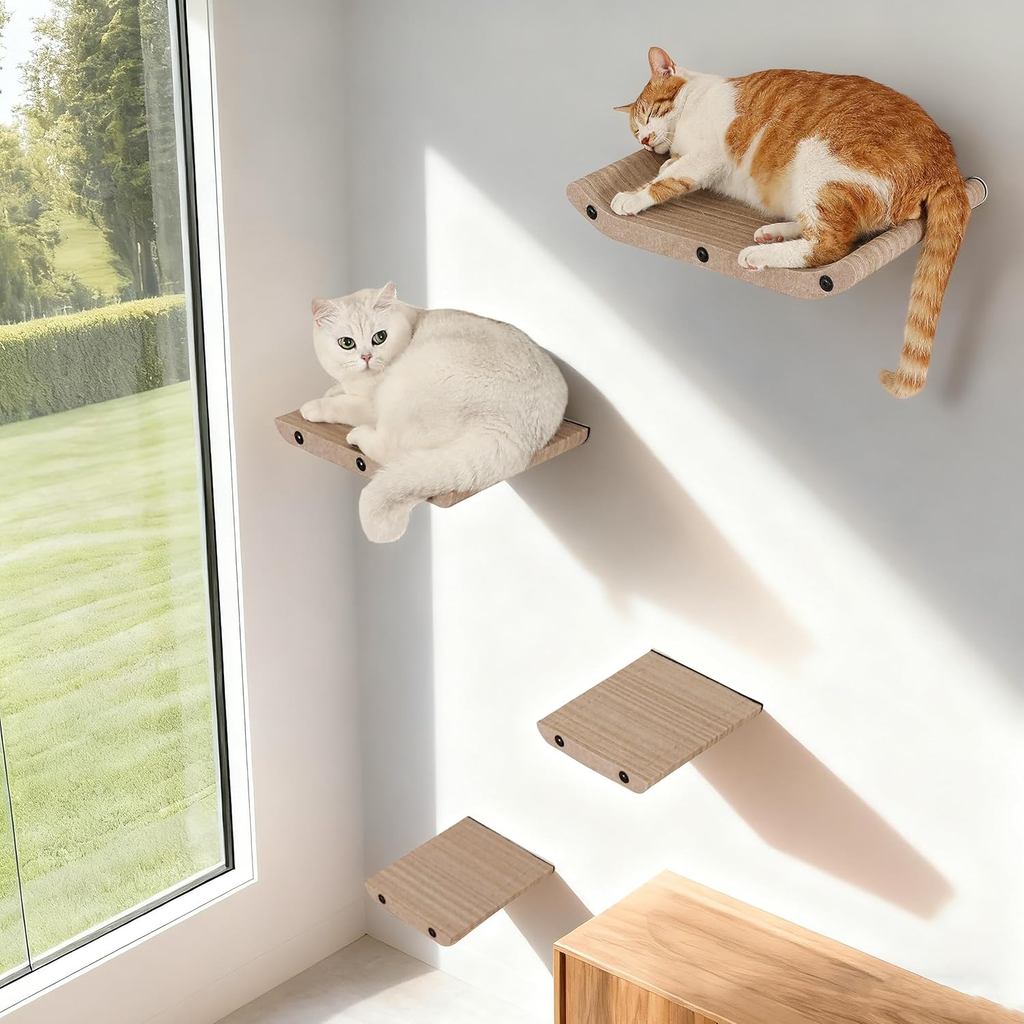
Indoor cats live in a world largely defined by the floor plan their humans provide. Wall mounted cat shelves add a vertical dimension to that world, giving cats places to climb, perch, observe, and rest above the activity of the household. For many cats, height equals safety and control: a high perch offers a vantage point over the room while keeping distance from toddlers, dogs, or the vacuum cleaner.
Enrichment is not only about toys. It is about giving cats choices and letting them express natural behaviors such as climbing, scanning from above, scratching, and moving along pathways. Wall shelves can support several of these behaviors at once, especially when they are arranged as a route rather than a single isolated platform. That said, shelves are one piece of a broader enrichment plan that should also include scratching surfaces, play, hiding spots, and social interaction on the cat’s terms.
Planning a Wall Shelf Layout Before You Buy
The most common mistake with wall mounted cat shelves is treating them as decoration. Cats benefit from a connected system: a series of steps, ledges, and resting platforms that let them travel from one part of a room to another without returning to the floor. Before purchasing anything, walk around the room and sketch a rough route.
- Start low and build up: The first shelf should be reachable from sturdy furniture or a low platform, so older or less confident cats are not forced into a large jump.
- Consider jump distance and landing space: Gaps between shelves should suit your cat’s size, age, and mobility. Senior cats and kittens generally need shorter gaps and wider landings.
- Create resting spots, not just stepping stones: Include at least one or two wider platforms where a cat can lie down comfortably, not only narrow ledges for transit.
- Keep sightlines open: Cats often prefer perches with a view of doorways, windows, and the main seating area.
- Account for household traffic: Avoid placing shelves where people regularly carry hot food, swing doors, or move tall objects.
If you rent or are unsure about wall damage, consider freestanding cat trees or window perches as an alternative, or discuss installation with your landlord first. Details about permitted fixtures vary by lease and location, so check your own agreement rather than assuming.
Choosing Shelves: Materials, Mounting, and Safety
Wall mounted cat shelves come in several broad types. The right choice depends on your cat’s weight, how many cats you have, and how the shelf will be used—active climbing versus quiet lounging.
| Shelf Type | Typical Use | Points to Check |
|---|---|---|
| Fabric-covered platforms | Resting and perching | Cover material durability, washability, frame strength |
| Wooden ledges | Stepping stones and pathways | Surface grip, edge finishing, screw and bracket quality |
| Carpeted steps | Climbing routes | Adhesion of carpet, weight rating, spacing between steps |
| Corner or curved shelves | Space-saving perches | Bracket design, fit in corners, clearance from doors |
| Shelf-and-scratcher combinations | Climbing plus scratching | Replaceable scratch surfaces, stability under pulling |
Mounting is where safety is won or lost. Shelves should be fixed into wall studs or into appropriate anchors rated for the wall material and the load. Drywall alone often cannot hold a cat launching onto a shelf, and the dynamic load of a jump is greater than the cat’s static weight. If you are not confident about wall types or anchors, a handyperson or contractor can help. Manufacturer instructions and weight ratings should be followed, and product designs and specifications can change over time, so verify current details with the seller.
Also check the wall itself: plaster, brick, tile, and drywall each require different fixings. Avoid mounting above radiators, heaters, or fragile items, and keep shelves clear of cords and blind pulls. For multi-cat homes, provide more than one route and more than one high resting spot so cats can avoid each other when they choose.
Arranging Shelves for Confidence and Exercise
A good arrangement lets a cat move in loops rather than dead ends. Cats often prefer routes with an escape option, so try to connect shelves to furniture, a cat tree, or a window perch at one or both ends. Staggering heights creates natural exercise: a low step, a medium ledge, a high lookout, then a descent on the other side of the room.
Placement near windows can add enrichment value, since many cats enjoy watching birds, leaves, and street activity. Be mindful of sun exposure and heat buildup on shelves in direct sunlight, and check that window treatments cannot be tangled or pulled down. If a shelf sits above a doorway, confirm clearance so people do not hit their heads or knock the cat.
Introduce the new layout gradually. Some cats explore immediately; others prefer to be lifted gently onto a low shelf or encouraged with a treat. Never force a cat onto a high perch. For anxious cats, start with one or two low platforms and add more once the cat is using them confidently. Senior cats may need ramps or closely spaced steps, and a veterinarian can advise if mobility is a concern.
Maintenance, Cleaning, and Long-Term Use
Wall shelves collect dust, fur, and the occasional hairball, and carpeted surfaces can hold odors over time. A routine that includes vacuuming or brushing platforms, spot-cleaning fabric covers, and checking fixings every few months will keep the setup pleasant and safe. Look for loose screws, wobbling brackets, frayed carpet, and any sign that an anchor is pulling away from the wall. If a shelf moves when pushed, stop using it until it is repaired.
Rotation helps prevent boredom. Moving a low-value shelf to a new position, swapping a resting platform for a scratcher attachment, or adding a new sightline can refresh a cat’s interest without a full rebuild. Replace worn scratch surfaces rather than waiting for them to disintegrate, and keep the number of resting spots roughly matched to the number of cats in the household.
Limitations and When to Choose Alternatives
Wall mounted cat shelves are not suitable for every home. Very heavy cats may exceed the rating of lightweight designs, and some wall constructions make secure mounting difficult or expensive. Renters may face restrictions, and households with limited wall space may find freestanding cat trees, window hammocks, or shelf-and-furniture combinations more practical. Cats with arthritis, vision loss, or balance issues may do better with floor-level enrichment and gentle ramps than with high jumps.
Finally, shelves are not a substitute for interaction. Play sessions with wand toys, food puzzles, scratching posts, and quiet hiding places all contribute to a cat’s wellbeing. Used as part of that mix, wall shelves can turn an ordinary room into a more three-dimensional, exploratory environment—one that respects the cat’s natural instincts while keeping safety and household realities in view.