In this guide
Living in a small apartment doesn’t mean your cat has to go without vertical territory. Cats climb, perch, and scratch by instinct, and a well-chosen cat tree can satisfy those needs without swallowing your living room. The challenge is finding one that fits your floor plan, your cat’s size, and your budget. This guide walks through what actually matters when shopping for a cat tree in a compact space, with practical picks by category and buying advice you can apply to whatever is available where you shop.
A quick note before the picks: product availability, prices, and specific designs change frequently, and manufacturers occasionally revise materials or dimensions without notice. Treat the models named below as examples of the types worth looking for, verify current specs and reviews before buying, and use the criteria in each section to evaluate alternatives.
What Makes a Cat Tree Work in a Small Apartment
In a cramped space, the best cat tree is the one that earns its footprint. Three factors matter more than anything else: a small or irregular base, height rather than width, and stability that doesn’t depend on a huge platform.
Footprint over volume. A tree that rises vertically on a base of roughly 15 to 20 inches per side takes up far less floor than a sprawling multi-level condo. Measure the spot you have in mind before you shop, including clearance for a door swing or closet.
Stability without bulk. Tall, narrow trees can wobble, and a wobbling tree is a tree your cat will avoid. Look for weighted bases, wall-anchoring hardware (many tall trees include a strap for this), and a base that is wider than the top platforms. If you rent, a single small screw or adhesive anchor is often enough and far less invasive than a furniture-sized footprint.
Multi-function design. In a small apartment, a cat tree that doubles as a scratching post, a window perch, or even a small side table works harder for the space it occupies. The more functions packed into one footprint, the better the trade-off.
Easy to move and clean. Lightweight trees are easier to reposition for cleaning or rearranging. Removable, washable covers or faux-fur surfaces that vacuum cleanly are worth prioritizing in a small space where the tree sits close to where you live.
Types of Space-Saving Cat Trees (and Who They Suit)
Not every compact tree is compact in the same way. Here are the main styles you’ll encounter, with notes on which cats and apartments they fit best.
| Type | Typical footprint | Best for | Watch out for |
|---|---|---|---|
| Tall, narrow tower | Small base, high climbing height | Active climbers; corner placement | Wobble on carpet; needs anchoring |
| Wall-mounted shelves and steps | Zero floor space | Renters allowed to drill; small rooms | Installation effort; weight limits |
| Window perch or hammock | Minimal, hangs on glass or sill | Sunbathers; studio apartments | Window type and suction reliability |
| Corner condo with hideaway | Fits into a 90-degree corner | Shy cats; multi-cat homes | Can be bulky at the base |
| Cat tree with built-in litter or storage | Similar to a small side table | Tiny apartments needing double duty | Litter access and cleaning |
| Over-the-door or furniture-mounted | None on the floor | Very tight spaces; temporary setups | Door or furniture must bear weight |
Most small apartments do well with a combination: one tall narrow tower in a corner plus a window perch, for example. Two small items often outperform one big one because they spread activity around the home and reduce competition in multi-cat households.
Practical Picks by Category
The models below are representative examples of each category. Names and designs shift over time, so confirm dimensions, materials, and weight ratings on the current product listing before you commit.
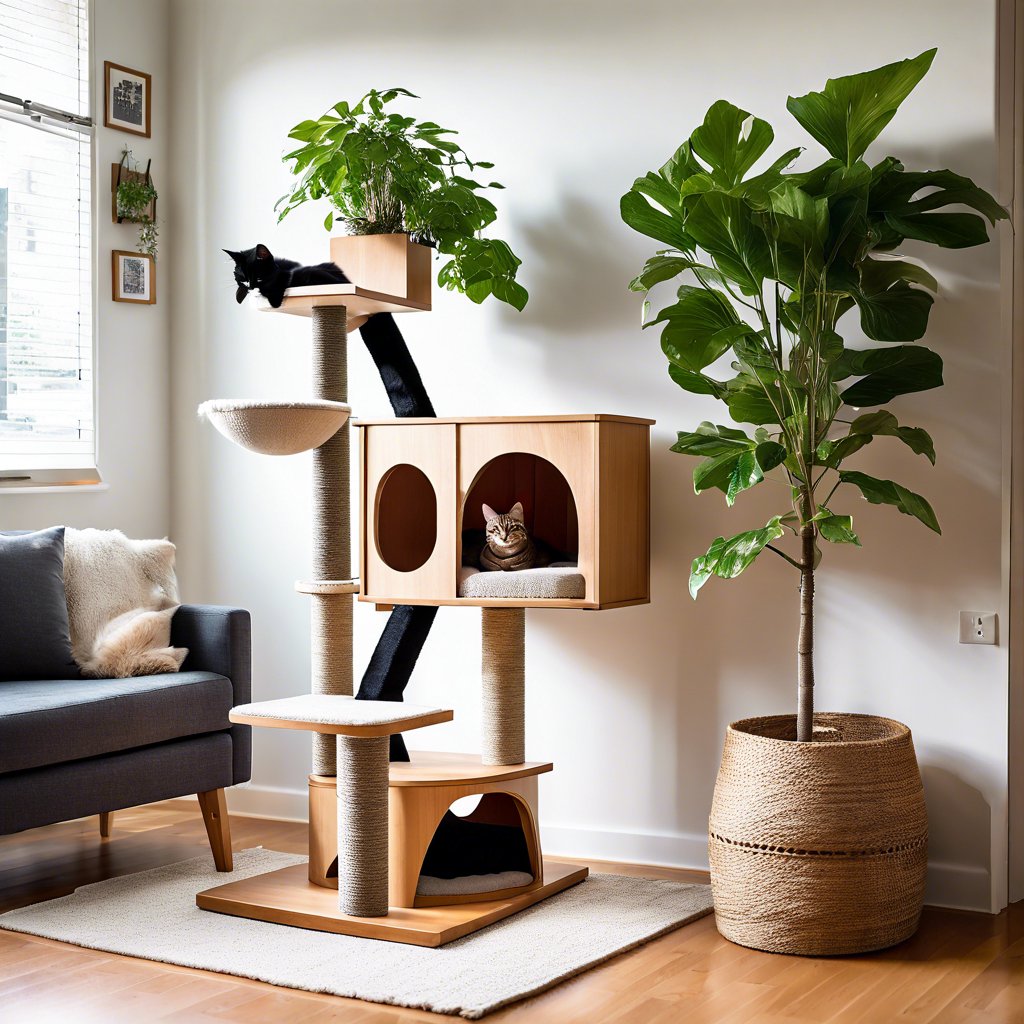
Best overall for tight corners: a tall, narrow tower. Look for trees around 60 to 75 inches tall with a base under about 20 inches square. Models in this mold from brands like Frisco, Yaheetech, and Feandrea appear frequently in this category, often with a top perch, a couple of mid-level platforms, and a scratching post wrapped around the trunk. The key check is the base-to-height ratio and whether wall-anchoring hardware is included. A tower like this gives a cat real climbing height in a footprint smaller than a dining chair.
Best for zero floor space: wall-mounted shelves. If your lease allows a few anchored screws, wall-mounted cat shelves turn unused vertical wall space into a climbing route. Sets from brands such as CatastrophiCreations and similar makers offer modular shelves, bridges, and hammocks. This is the most space-efficient option available, but installation quality matters enormously — mount into studs wherever possible, and follow the manufacturer’s weight limits.
Best budget pick: a compact two- or three-level tree. Entry-level trees from brands like Amazon Basics, Go Pet Club, and Furhaven often come in under $50 and fit in a corner. Expect plush-covered particle board rather than solid wood, and check reviews for stability complaints. These are a reasonable first tree for a kitten or a smaller adult cat, and easy to replace if your cat turns out to be a heavy climber.
Best for sun-seekers: a window perch. Suction-cup window hammocks from K&H and similar brands cost little and take up no floor space at all. They work best on smooth glass and need periodic re-seating; some cats are too heavy or too enthusiastic for suction alone, so check weight ratings carefully.
Best for multi-cat small homes: a corner condo with a hideaway. A corner-shaped tree with a covered cubby gives shy cats somewhere to retreat and gives two cats separate perches without two separate footprints. Vesper and similar furniture-style brands make compact corner options, though they tend to cost more.
Best for double duty: a tree that looks like furniture. A growing number of designs blend a cat tree with a side table or shelf unit. These suit studio apartments where every piece of furniture is visible. They usually sacrifice some climbing height, so they suit calmer cats or serve as a secondary tree.
How to Choose: A Practical Checklist
Before you buy, run through these questions. They’ll filter out most unsuitable trees faster than any list of model names.
- Measure the space — twice. Note the floor footprint, the ceiling height, and any nearby doors, radiators, or furniture. A tree that blocks a closet or a walkway will annoy you daily.
- Match the tree to your cat’s size and energy. A large, heavy cat needs a wider base and sturdier platforms; a kitten can start small and upgrade later. Vigorous climbers benefit from wall anchoring.
- Check the base and anchoring. Prefer a base wider than the top platform, weighted feet, and included anti-tip straps. Reviews mentioning wobble are a red flag.
- Look at scratching surfaces. Sisal-wrapped posts last longer than carpet-wrapped ones and are more appealing to most cats. Carpet is softer but sheds and wears faster.
- Confirm platform sizes. Perches should be large enough for your cat to lie down fully, not just sit. Small perches get ignored.
- Consider assembly and cleaning. Small apartments often mean assembling in a tight spot. Check whether tools are included and whether covers are removable.
- Read recent reviews for stability and material complaints. Patterns across many reviews are more informative than any single rating, and they’ll tell you if a design has changed.
Placement Tips for Small Spaces
Where you put the tree matters as much as which one you buy. Cats want height with a view, so a corner near a window is usually the prime spot. Placing the tree against a wall or in a corner also reduces wobble and makes a tall, narrow design feel more secure.
Avoid blocking heating vents, and keep the tree out of the main walking path between your kitchen and living area — a tree that gets bumped constantly will be avoided. If you have a wall-mounted setup, route it along a wall your cat already frequents rather than in an unused hallway.
Finally, give the tree a chance. Some cats ignore a new tree for days before claiming it. Placing a favorite blanket or a sprinkle of catnip on the top perch often speeds up the process. In a small apartment, one well-placed, stable tree plus a window perch is usually enough to keep a cat content — and to keep your sofa scratch-free.