What Size Air Purifier Do I Need for Pet Owners?
Pet owners face a different air purification challenge than most people. Pets shed dander, hair, and fur, and they bring in odors from litter boxes, grooming, and accidents. A standard room-size recommendation often doesn’t account for the extra particle load a pet creates. So the short answer is: size for your room, then add extra coverage for the pet factor.
Here’s how to figure out the right size air purifier for your home, why pets change the math, and what to verify before you buy.
Start With Your Room Size
Before you look at any air purifier, measure the room you want to clean. Multiply the length by the width to get the square footage.
For small, enclosed spaces, the sizing is simple. A small or medium air purifier is generally sufficient for rooms up to 300 square feet, which makes it a reasonable starting point for cozy bedrooms or bathrooms [1]. That type of unit is often enough for a single, smaller room if the pet load is modest.
But if you have a larger room, an open floor plan, or multiple pets, you need a bigger purifier. Larger machines are rated for bigger areas, and some manufacturers list the recommended room size directly on the product page. Look for numbers like “562 sq. ft. at 5 air changes per hour” or “234 sq. ft. at 5 air changes per hour” when comparing models [2]. The “air changes per hour” number matters because it tells you how often the purifier can cycle the entire air volume in that space. A unit rated for the correct room size and air changes will do a much better job than one that is underpowered.
Pets Change the Sizing Math
Manufacturer coverage claims assume ideal conditions. In a home with pets, you shouldn’t trust those numbers as-is.
For pet homes, the practical rule is to buy 20 to 30% more coverage than your room size to account for the higher particle load [5]. That extra margin means your purifier won’t have to work as hard, and it will still handle the dander and fur that a pet constantly produces.
The reason is simple: pet households deal with a constant stream of dander, fur, tracked litter dust, and odors. Those require higher filtration capacity, specialized pre-filters, and smart design [5]. An air purifier that barely covers a room will struggle to keep up.
So if your living room is 1,200 square feet, you should look for a purifier rated for about 1,600 square feet, not one rated for exactly 1,200 [5]. The same logic applies to smaller rooms. A 300-square-foot bedroom should get a purifier rated for roughly 360 to 390 square feet. If you follow a standard sizing chart and buy a 300-square-foot unit for a pet-owning household, you’re likely to be disappointed.
Suggested read: Can Air Purifiers Help With Pet Shedding?
Reconcile General Sizing With the Pet Rule
You may see a general guideline that says a small or medium air purifier is fine for rooms up to 300 square feet [1]. That’s true for a normal room. But for pet owners, the guideline needs a cushion.
Use this formula:
1. Measure your room in square feet.
2. Multiply that number by 1.25 (a 25% buffer) to get a minimum coverage target.
3. Compare that target against the purifier’s listed coverage area.
For example, a 200-square-foot bedroom becomes a 250-square-foot target. A 500-square-foot living room becomes a 625-square-foot target. That extra 25% is your pet buffer. Some buyers prefer the full 30% for homes with multiple large pets or heavy shedding [5]. Either way, an under-sized purifier won’t give you the air quality you’re paying for.
Filter Type Is Just as Important as Size
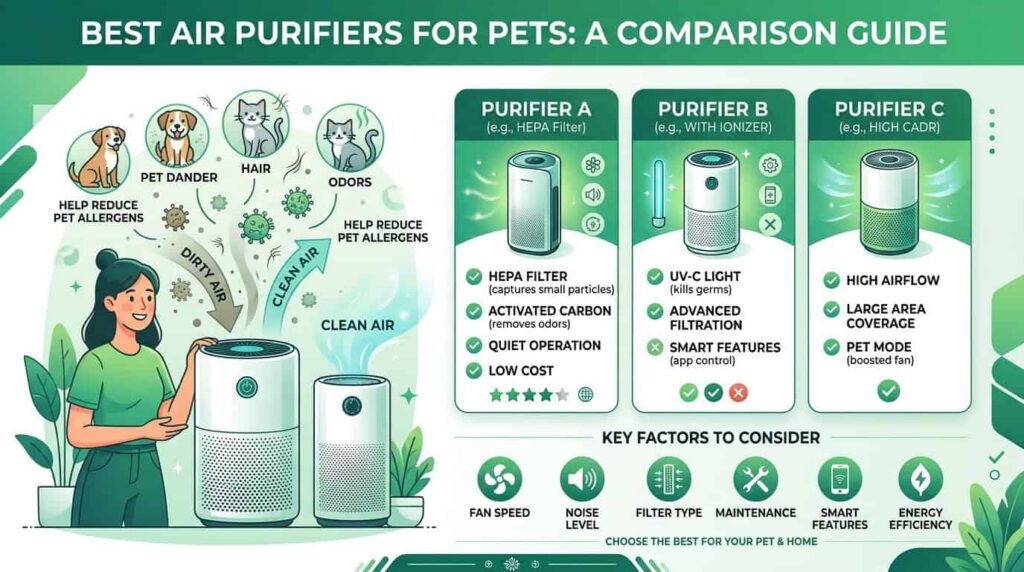
Sizing is only half the equation. The other half is filtration. Pet owners need two things in an air purifier: a true HEPA filter and activated carbon filter.
True HEPA is the gold standard for pet allergens. True HEPA filters are the best at capturing the most minute particles like pet dander and hair [4]. For pet dander and hair, True HEPA rated filters are specifically the most effective option [4]. When comparing models, make sure you’re looking at “True HEPA” and not a vague “HEPA-type” claim [5]. Pet allergies often involve watery eyes, an itchy nose, and trouble breathing, and HEPA filtration is a key part of reducing those allergens [3].
Activated carbon handles the odor side. HEPA filters capture particles but do not neutralize odors [5]. A quality activated carbon layer absorbs volatile organic compounds (VOCs), pet odors, and litter box smells [5]. If you’ve got a litter box or a dog that gets muddy, an air purifier that only uses HEPA won’t solve the smell problem. Look for a unit that combines both HEPA and activated carbon filters for optimal pet air quality [4].
There’s a practical warning here too: cheap carbon filters often use only a thin carbon mesh. For lasting odor control, look for units with substantial carbon weight [5]. Heavier, denser carbon will last longer and do more work in a pet home.
What About CADR Numbers?
Some product listings include a Clean Air Delivery Rate, or CADR. This metric can help you compare how much air a purifier can clean at different speeds.
From the cited sources supplied, one large-room unit reports a top speed PM1 CADR of 375 cfm, while a smaller unit reports 156 cfm [2]. A unit designed for a smaller room will generally have a lower CADR. If you have a pet-heavy house, you want a machine with a CADR that matches your room size plus your 25% buffer. If the listing does not include CADR, use the recommended room size and air changes per hour instead.
Suggested read: Air Purifier Maintenance for Pet Owners: Cleaning and Filter Care
Pay Attention to Filter Replacement
A purifier is only as good as its filters. Pet owners generate a lot of filter-clogging material, so filter replacement matters a lot.
Diligent filter replacement and maintenance is crucial to ensuring the purifier keeps removing pet allergens and odors [4]. Some filters last 12 to 15 months, others are designed for up to five years, depending on the model and how heavily it’s used [2]. Before you buy, check the filter lifespan and replacement cost. If you have shedding dogs or a multi-cat home, you may need to replace filters more often than the manufacturer’s estimate. Check the current product listing for the filter’s rated lifespan and the price of replacement filters.
Match the Filtration to the Odor Problem
Every pet home has different odor sources. An air purifier with an activated charcoal filter will remove as much pet odor as possible from the room, and it will also capture VOC particles [3]. That’s useful if you’re dealing with litter boxes, accidents, grooming, or concentrated pet smells.
You can also find models with dedicated pet pre-filters or washable mesh pre-filters [5]. A dedicated, replaceable pet pre-filter can extend the life of the HEPA filter by catching hair and fur before it reaches the main filter. A washable mesh pre-filter is simpler and might not capture as much fine hair. Look for the filter arrangement that matches how much hair your pets actually produce.
Noise and Continuous Use
Pet owners often run air purifiers 24/7, especially if the bedroom or living room is the main pet zone. Noise levels matter more when the machine is always on.
Some listings list noise in decibels at each speed. From the cited sources, one model ranges from 39.1 dB on speed 1 to 57.8 dB on turbo, while another runs from 42.5 dB to 61.5 dB [2]. If a unit is for your bedroom, you’ll want a quieter speed that still provides enough coverage. Check the noise level at the operating speed you actually plan to use [5]. A purifier that’s too loud at a speed is a purifier you’ll turn off — and that defeats the purpose.
Sizing Worksheet for Your Pet-Friendly Home
Here’s a quick way to apply the pet-owner rule to your own rooms:
– Bedroom, 150 sq ft: Target coverage 187 to 195 sq ft.
– Bedroom, 200 sq ft: Target coverage 250 to 260 sq ft.
– Living room, 400 sq ft: Target coverage 500 to 520 sq ft.
– Open living area, 1,200 sq ft: Target coverage 1,500 to 1,560 sq ft.
Remember that a purifier rated for 1,600 sq ft is suitable for a 1,200 sq ft open living area with pets [5]. Use the upper end of the range for multi-pet homes.
What to Verify Before You Buy
Prices, stock, discounts, ratings, shipping, availability, package contents, accessories, and compatibility can all change. Always verify the current manufacturer or retailer listing before you purchase. Don’t rely on a review or guide snapshot as guaranteed current information.
Suggested read: Best Dog Toys for Teething Puppies: Chew-Proof Picks
When you’re ready to buy, double-check these three things on the product page:
– The listed coverage area. Compare it to your target from the formula above.
– The filter type. Look for True HEPA plus activated carbon.
– The replacement filter cost and lifespan. Make sure you’re comfortable with the long-term upkeep.
Also, confirm whether the purifier has a pre-filter that can catch pet hair. A dedicated pet pre-filter or washable mesh will affect how often you need to clean the unit and replace the HEPA filter [5].
Bottom Line for Pet Owners
Sizing an air purifier for a pet home is not the same as sizing one for a normal room. The general small/medium rule for rooms up to 300 square feet is a starting point, but pet owners should add a buffer of 20 to 30% [1][5]. In a pet home, the correct question isn’t “What size purifier does this room need?” It’s “What size purifier does this room need *with this pet load?*”
Choose a True HEPA filter for dander and hair, add activated carbon for odors, and check that the unit’s coverage rating covers your room plus extra margin [4][5]. Maintain the filters on schedule, and you’ll have a much more comfortable living space for you and your pets.
—
Sources
[1] Choosing the Right Air Purifier Size for Your Pets\nhttps://www.nuwavenow.com/blogs/learn/best-home-air-purifier-for-pets-size
[2] The best air purifiers for pet odor, hair and dander\nhttps://housefresh.com/air-purifiers-for-pets
[3] Air Purifiers for Pet Owners: Everything You Should Know\nhttps://medifyair.com/blogs/news/everything-pet-owners-need-to-know-about-air-purifiers
[4] Air Purifier Filters for Pet Owners: What to Consider\nhttps://www.breathenaturally.com/blogs/faq/air-purifier-filters-for-pet-owners-what-to-consider
Suggested read: Best Chew Toys for Large Breed Dogs: Durable Picks for Power Chewers
[5] Best Air Purifier for Pets 2026: Complete Buyer's Guide | WISESKY\nhttps://wisesky.com/blogs/category-product-tips/how-to-choose-the-best-air-purifier-for-pets-in-2026-a-complete-buyers-guide
[6] Air Purifier for Pets: 5 Reasons Pet Owners Need One – Levoit\nhttps://levoit.com/blogs/levoit-blog/hepa-air-purifier-for-pets