If you share your home with a dog or cat, you’ve probably noticed that air purifiers fall into two camps: models advertised with a “pet filter” and models built around a “True HEPA” filter. The marketing suggests they’re different technologies, and that you must pick a side. In reality, the comparison is less about rivalry and more about understanding what each label actually promises. This guide breaks down what pet filters and HEPA filters do, where each one excels, and how to decide what your household really needs.
What a “Pet Filter” Actually Is
Here’s the first thing to know: “pet filter” is a marketing label, not a technical standard. There is no industry certification that defines what a pet filter must contain or how well it must perform. That said, filters marketed for pet households usually share a common design — they are combination filters that bundle several filtration stages into one replaceable cartridge.
A typical pet-specific filter includes:
- A coarse pre-filter mesh that traps pet hair, fur clumps, and larger visible debris before they reach the finer filter layers. On many models this layer is washable.
- HEPA or HEPA-grade media that captures fine particles, including pet dander, dust mite debris, and pollen.
- Activated carbon that adsorbs odor molecules — the “wet dog,” litter box, and general pet smells that plain particle filters cannot touch.
Some manufacturers also add antimicrobial treatments or specialized odor pellets to their pet filter variants. And occasionally, a “pet filter” is simply a standard filter with new packaging and a higher price tag. This is why it pays to read the filter’s construction details rather than relying on the name on the box.
How HEPA Filtration Works (and Why It Matters for Dander)
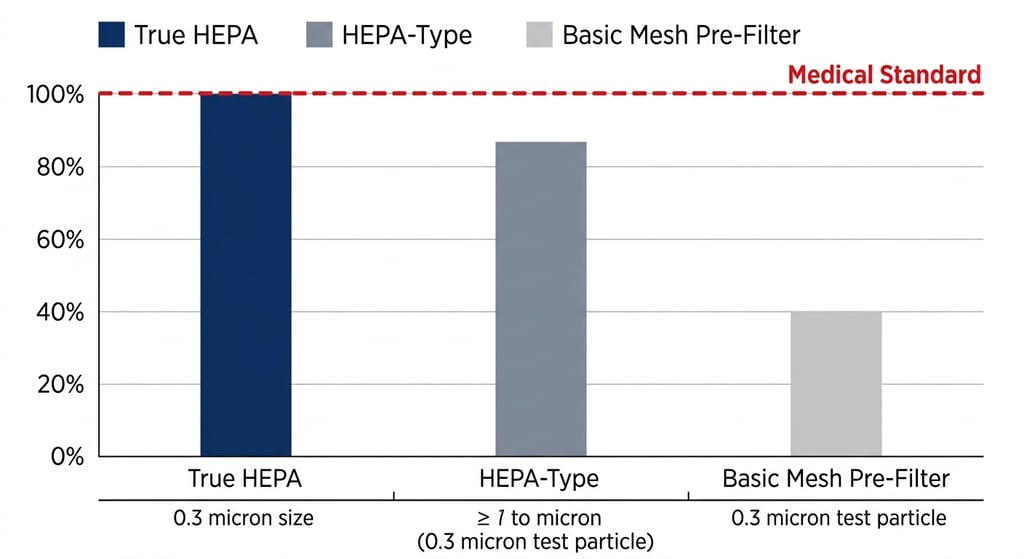
HEPA stands for High-Efficiency Particulate Air. To be called a true HEPA filter in the industry’s standard sense, a filter must capture at least 99.97% of airborne particles measuring 0.3 microns — a size chosen because it is among the hardest for filters to trap. Genuine HEPA filtration is mechanically verified, which is what separates it from vague claims like “HEPA-type” or “HEPA-like,” terms that have no enforced performance standard behind them.
For pet owners, this matters because of what dander actually is. Pet dander consists of tiny flakes of skin shed by animals, often carrying proteins found in pet saliva, urine, and sebaceous glands. These particles are microscopic, lightweight, and can remain suspended in the air for long periods before settling on furniture, bedding, and floors. HEPA media is extremely well suited to capturing particles in this size range.
What HEPA does not do is equally important to understand:
- It does not capture gases or odors. Smell is caused by airborne molecules, not particles, so a HEPA-only purifier will do little for a litter box or wet-fur odor.
- It is not designed for large debris. Pet hair is far too big to stay airborne for long, and when it does get pulled into a purifier, it can clog delicate HEPA media quickly if there’s no pre-filter in front of it.
Pet Filter vs HEPA: Side-by-Side Comparison
The table below summarizes how the two options typically stack up. Remember that many “pet filters” contain HEPA media, so the comparison is really about what surrounds the HEPA layer.
| Feature | Pet Filter (Combination) | HEPA-Only Filter |
|---|---|---|
| Pet hair and fur | Excellent — dedicated pre-filter mesh catches it before it clogs finer media | Poor to fair — hair is too large to filter efficiently and can shorten filter life without a pre-filter |
| Pet dander | Very good, provided the filter includes true HEPA-grade media | Excellent — this is exactly what HEPA is built for |
| Pet odors | Good to excellent — activated carbon adsorbs odor-causing molecules | Minimal — particle filters do not remove gases or smells |
| Allergy and asthma focus | Very good when HEPA media is certified | Excellent — easiest to verify performance claims |
| Maintenance | Often includes a washable pre-filter; one cartridge to replace | Simpler design; pre-filter and carbon may need separate purchases |
| Replacement cost | Can be higher per filter due to multiple layers | Often lower for the HEPA filter alone, but add-ons increase total cost |
| Best suited for | Shedding pets, noticeable odors, mixed particle-and-smell problems | Allergy-driven households where dander — not odor — is the main concern |
The Real Answer: It’s Usually Not Either/Or
Here’s the twist that most comparison articles miss: in practice, this isn’t a head-to-head contest. A well-designed pet filter contains HEPA media — the “pet” label describes the extra layers added around it, primarily the pre-filter and the carbon. Conversely, a HEPA-only purifier can be upgraded with a washable pre-filter and a separate carbon filter to approximate a pet-specific setup.
Suggested read: How to Choose the Best Pet Accessories Shop for Your Furry Friend
So the more useful question isn’t “pet filter or HEPA?” but rather: what combination of pre-filtration, HEPA media, and odor control does your home need? A household with a heavy-shedding husky and a noticeable “dog smell” has different needs than one with a short-haired cat and an allergic family member and no odor complaints. Matching the filter stack to the actual problem is what delivers results.
When Each Option Makes Sense
Use these scenarios as a starting point:
- Choose a pet-specific combination filter if: odor is a real complaint in your home, your pets shed heavily, you want the convenience of a single replacement cartridge, or you’d rather not assemble a multi-stage system yourself.
- Choose a HEPA-focused purifier if: allergies or asthma are your primary concern, odor isn’t an issue, you want the easiest filtration claims to verify, or you prefer buying filters à la carte to control long-term costs.
- Skip the premium entirely if: the “pet filter” version of a purifier is identical to the standard version except for branding. Compare the filter construction specs before paying extra for the word “pet.”
Features That Matter More Than the Label
Whether you go with a pet-branded combination filter or a HEPA-centric unit, several design details predict real-world performance far better than the name on the box:
- Pre-filter quality. A large, washable pre-filter dramatically extends the life of the HEPA layer in a shedding household. If it’s washable, clean it regularly instead of waiting for replacement day.
- Amount of activated carbon. A thin, sprayed-on carbon coating saturates quickly and does little after a few weeks. A thicker carbon bed or granular carbon panel handles odors much longer.
- Room-size rating and CADR. The Clean Air Delivery Rate tells you how much filtered air the unit moves. A purifier that’s undersized for your room will underperform no matter what filter it uses.
- Sealed filtration system. Air follows the path of least resistance. In poorly sealed purifiers, unfiltered air slips around the filter edges, bypassing the media entirely. Look for units that describe a sealed filter compartment.
- Filter availability and cost. A cheap purifier with expensive, proprietary replacement filters can cost more over five years than a pricier unit with affordable consumables. Price the replacement filters before you buy the machine.
- Noise on the settings you’ll actually use. Filtration only works while the unit runs. A purifier quiet enough for continuous use in a bedroom or living room removes far more dander over a day than a loud one you switch off.
Getting the Most from Any Filter You Choose
No air purifier — pet-branded or HEPA-certified — can out-filtrate a home where dander is being generated faster than it’s removed. Pair your purifier with these habits for the best results:
- Run the purifier continuously or on an automatic mode rather than only when smells are noticeable. Dander is generated constantly.
- Place the unit where your pets spend the most time, ideally with clear airflow on all sides and away from walls and curtains.
- Groom pets regularly, ideally outdoors or in an easy-to-clean area, to reduce the amount of hair and dander released indoors in the first place.
- Vacuum frequently with a vacuum designed to trap fine particles, since dander that settles on floors and upholstery becomes airborne again with everyday activity.
- Wash or replace pre-filters on schedule. A pre-filter matted with fur chokes airflow and strains the motor.
- Replace HEPA and carbon filters by the manufacturer’s timeline, not by appearance. A saturated carbon filter can look perfectly fine while doing almost nothing for odors.
- Keep bedroom air prioritized. Since you spend a large share of your day in one room, a purifier there delivers outsized benefit for allergy sufferers.
Bottom Line
For pet hair and dander specifically, HEPA filtration is the workhorse — it’s the technology that actually captures the microscopic dander particles responsible for most pet allergies. The “pet filter” label, at its best, describes a smart package: a pre-filter that handles the hair HEPA was never meant to catch, HEPA media for the dander, and activated carbon for the smells that no particle filter can address. At its worst, it’s just branding.
Check what’s inside the filter, verify that the HEPA media is genuine, size the purifier to your room, and maintain the filters on schedule. Do that, and the debate between “pet filter” and “HEPA” resolves itself: the best choice is the one that combines certified fine-particle filtration with the pre-filtration and odor control your particular pets demand.